What's Inside?
- Cassie’s dream wedding collapses into chaos when Nate’s debt catches up, exposing harsh truths that reshape her future choices forever.
- Jules’ storyline explores control and survival, revealing how financial independence comes with emotional cost in a world driven by power.
- The shocking ending hints Cassie may turn to OnlyFans, not for desire but survival, redefining her arc this season completely.
Euphoria has always thrived in the space between beauty and discomfort, and Season 3, Episode 3 leans fully into that tension. Titled “The Ballad of Paladin,” the episode builds like a fever dream, stacking glossy spectacle on top of emotional chaos until it all collapses at once. What begins as a lavish wedding quickly spirals into something far darker, exposing the fragile illusions each character clings to. At its core, this chapter is about control, who has it, who is losing it, and what people are willing to trade to get it back. By the time the credits roll, the cost of those choices feels brutally clear.
Euphoria Season 3 Episode 3 Ending: Wedding Night Sets Up Sydney Sweeney’s OnlyFans Arc

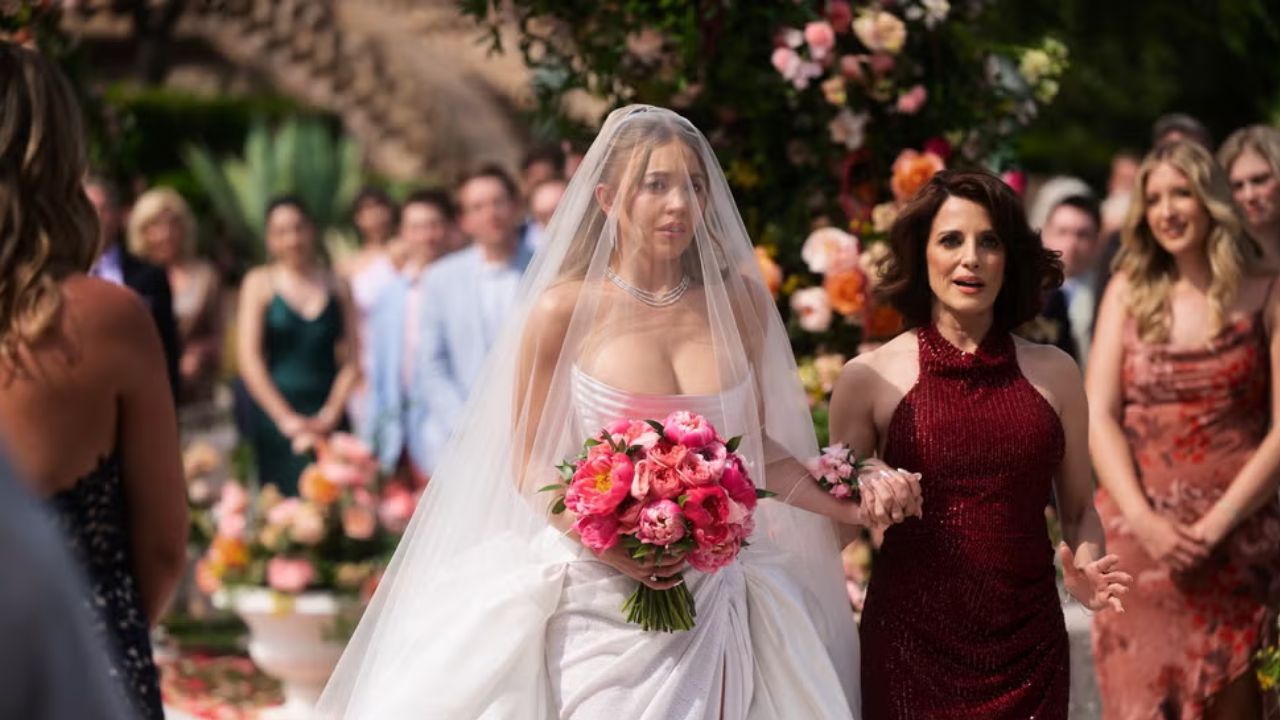
Sydney Sweeney’s character Cassie’s wedding to Nate should have been her moment of triumph. The setting is extravagant, the aesthetic is flawless, and every detail reflects the fantasy she has chased for years. Yet even at its most polished, something feels off. The smiles look rehearsed. The emotions feel slightly out of sync. And as the episode progresses, that unease begins to take shape.
The turning point arrives when Naz crashes the reception. His presence cuts through the illusion with surgical precision. “I used to be your husband’s friend,” Naz says. “I’m gonna become his worst fucking nightmare.” In a single moment, the narrative shifts. Nate is no longer the powerful figure Cassie believed she married. Instead, he is exposed as someone drowning in debt, clinging to appearances while everything underneath crumbles.
What follows is not just a disruption of the wedding, but a dismantling of Cassie’s worldview. On the drive home, she begins to grasp the truth. The life she imagined, built on wealth and stability, does not exist. Nate’s promises feel hollow, even as he tries to salvage the night with grand gestures and familiar reassurances.
Then comes the final blow. Inside their home, Naz and his enforcer are waiting. The violence that unfolds is sudden and brutal. Nate is beaten while Cassie watches, her shock quickly turning into a desperate, almost childlike frustration. Her reaction is telling. She is less focused on the danger and more consumed by the fact that her perfect day has been ruined. It is darkly comic at first, then deeply unsettling.
The scene reaches its most disturbing point when Naz cuts off Nate’s toe, leaving behind a clear message. This is not just about money. It is about power and consequence. And in that moment, Cassie is forced to confront a reality she can no longer ignore.


Nate’s warning lingers. He tells her that some women inherit fortunes, while others inherit debt. It is not just a line. It is a roadmap for what comes next. Cassie is now tied to Nate’s failures as much as his promises. Survival, not romance, becomes the priority.
This is where her potential OnlyFans storyline begins to take shape. The seeds were planted earlier, but now the stakes are different. What might have once been a choice driven by vanity or curiosity becomes something far more urgent. If Cassie turns to it, it will not be about attention. It will be about necessity. The episode reframes her agency in a way that feels both empowering and tragic.
Euphoria Season 3 Episode 3: Jules’ Arc and the Cost of Control

While Cassie’s story explodes in the final act, Jules’ journey runs parallel, offering a quieter but equally unsettling exploration of control. The episode opens with her backstory, tracing how she enters the world of transactional relationships. It begins almost casually, framed as a practical solution to financial pressure. But it does not stay that way for long.
Jules approaches it with hesitation, aware of the risks. Yet the logic presented to her is difficult to ignore. “Hold out until the money is right,” she is told, a line that captures the transactional mindset she is stepping into. What follows is a gradual shift. What starts as a means to an end becomes a lifestyle that offers both freedom and confinement.
Her experiences grow more intense, more complicated. The men she meets are not just clients. They represent different forms of power, each interaction testing her boundaries in new ways. When she becomes involved with Ellis, the dynamic turns especially uneasy. His chilling remark, “I slice women open for a living: There’s very little that makes me uncomfortable,” hangs over their relationship like a warning.
Yet Jules continues. She earns more than she ever imagined, but the emotional cost becomes harder to ignore. One of the episode’s most haunting moments captures this perfectly. As she is wrapped in plastic, reduced to an object, the illusion of control slips away. Ellis’s words, “I just might keep you forever,” underline the imbalance at play.
Jules’ storyline mirrors Cassie’s in subtle ways. Both are navigating systems where their bodies become currency. Both believe, at least initially, that they can control the terms. And both are confronted with the reality that control is often an illusion.
Euphoria Season 3 Episode 3: A Wedding That Reveals More Than It Celebrates
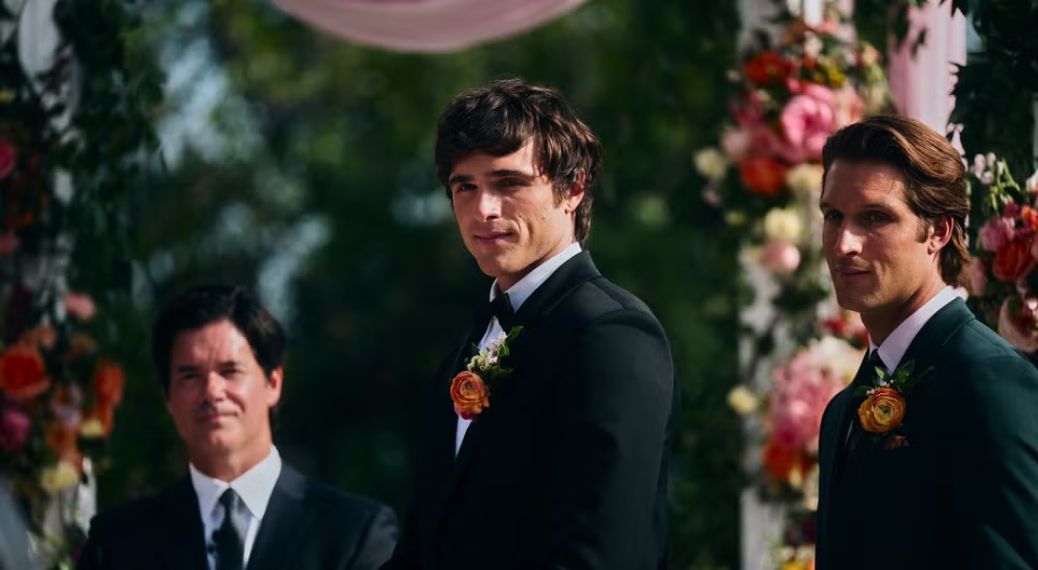
The wedding itself serves as the episode’s centerpiece, but it is less a celebration and more a stage. Everything about it feels heightened, almost exaggerated. From the choreography of the first dance to the carefully curated outfits, it is designed to impress. Yet beneath that surface, tension simmers.
The guest interactions add layers to the discomfort. Jules’ encounter with Cal is particularly striking. “Remember me?” she asks. His response, “How could I forget? It’s not every day you f**k one of your son’s high school classmates,” is blunt and unsettling. “And record it,” she reminds him, refusing to let the moment pass without acknowledgment.
Their conversation is loaded with history and unease. Cal’s attempts at casual conversation only deepen the discomfort, especially when he comments on her appearance. It is a reminder of how past actions continue to shape the present, even in spaces meant for celebration.
Meanwhile, Cassie’s emotional state fluctuates throughout the ceremony. Her mother’s speech, filled with its own regrets, casts a shadow over the moment. By the time Cassie reaches the altar, her tears feel less like joy and more like a warning.
Even the smaller details contribute to the episode’s tone. The questions that arise during the hour reflect its surreal quality. “What the heck is this choreographed first dance?” “Why would Jules engage in conversation of any sort with Cal?” “Is that toe salvageable?” They capture the absurdity of a situation that feels both hyper-real and strangely detached.
In the end, the wedding reveals more than it conceals. It exposes the cracks in each character’s facade, turning what should have been a beginning into something closer to an unraveling.
As the episode closes, the fallout is still unfolding. Rue’s storyline, with its own escalating tension, hints at further complications ahead. But it is Cassie and Jules who linger in the mind. Their paths, though different, are now defined by the same question. How far are they willing to go to regain control in a world that keeps taking it away?
The flowers may have been beautiful. But everything else tells a very different story.